
Remote work is now a standard operating model for many businesses. It shapes how teams collaborate, how managers lead, and how organizations measure results. Companies that rely on distributed teams need more than flexibility. They need consistency, clarity, and performance.
Succeeding in a remote work environment requires clear planning. Without clear habits and systems, remote teams lose focus. Communication slows down. Accountability declines; performance drops over time.
This challenge applies to employees, contractors, and companies using remote outsourcing or working with temp agencies for remote work. Location alone does not define success. Consistent daily execution determines success.
The following four strategies focus on what actually works. They help individuals perform better and help organizations build stable, productive remote teams. Each strategy is practical, easy to apply, and fits how remote work functions today.
Flexibility is one of the main benefits of remote work. Without structure, it quickly becomes a liability.
In a remote work environment, there is no physical separation between work and personal life. This makes it easy to overwork or lose focus. A clear daily structure solves both problems.
Remote professionals need defined start and end times. This creates clear boundaries and improves concentration. It also reduces fatigue caused by constant task-switching.
A structured workday supports better focus. It helps people prioritize meaningful work instead of reacting to messages all day.
Strong daily structure usually includes:
These habits improve productivity without increasing pressure. They also make collaboration easier because availability is predictable.
For many remote teams, structured routines support better task planning, clearer deadlines, and fewer interruptions. This is especially important for people in a remoto job, where teams work across different time zones.
Daily structure also improves accountability. When work follows a clear routine, missed deadlines and delays appear faster. This benefits managers and team members alike.
Teams that work from home consistently benefit from clear routines that support concentration and task ownership. Clear work habits help remote professionals stay focused and deliver consistent results, even without constant supervision. A dedicated workspace, daily planning, and energy management support long-term performance. These habits support effective how to work from home routines and long-term performance.
Communication is the foundation of remote work success. In a traditional office, teams resolve small issues informally, often without planning. In a remote work environment, unclear communication creates delays and confusion. Small gaps quickly become work problems.
Remote teams need communication that is direct, specific, and documented.
Every message should be clear about:
This applies to managers, team leads, and individual contributors.
Written communication matters more in remote teams. Chat tools, project boards, and shared documents replace in-person conversations. If something matters, teams must write it clearly.
High-performing remote teams use:
This level of clarity reduces follow-up questions and unnecessary meetings. It also helps new team members onboard faster.
For companies using remote outsourcing, communication standards are critical. Distributed teams often work across cultures and time zones. Clear language prevents confusion and keeps work moving forward.
Precision does not mean rigidity. It means respect for time and expectations.
Remote communication also requires intention. Not every message needs an immediate response. Clear priorities help teams focus on what matters most.
Many remote teams struggle because communication becomes reactive instead of planned. Clear rules for response times, meetings, and documentation improve flow and trust.
Strong communication habits help teams collaborate smoothly, even without overlapping schedules. Clear written instructions, consistent updates, and visible workflows reduce uncertainty and improve execution. These principles support how to work from home with clarity and intention.
In a remote work environment, performance depends heavily on self-management and accountability.
Remote professionals must manage their time without constant oversight. They must communicate progress proactively and flag issues early. This requires focus and clear work habits.
Key remote-ready skills include:
These skills support consistent performance across roles and industries.
Companies that hire through temp agencies for remote work often prioritize speed. Skill readiness should remain a core hiring requirement. A candidate who lacks remote discipline will struggle, regardless of experience.
Remote teams function best when individuals take ownership of their work. This reduces constant oversight and builds trust.
Skill development also affects retention. Remote workers who understand expectations and manage their workload effectively are more engaged and less likely to burn out.
This applies equally to entry-level roles and leadership positions.
Organizations that develop these skills see better results. Teams collaborate more smoothly. Managers spend less time correcting issues. Results improve over time.
Remote professionals who succeed long term share similar traits. They manage distractions, communicate clearly, and maintain consistent output. These qualities define reliable remote contributors and reflect strong remote worker skills in distributed teams.
As remote teams grow, clear systems keep work organized and visible. Without them, fragmented information slows execution and creates delays.
In a healthy remote work environment, systems provide clear and consistent guidance.
Essential systems include:
These tools create visibility. They help teams understand priorities and progress without constant check-ins. Systems are especially important for companies using remote outsourcing. Standardized processes reduce friction when teams operate across regions.
Consistency matters more than complexity. Simple systems that everyone uses correctly outperform complex tools that create confusion.
Remote teams should know:
Clear systems also improve onboarding. Clear expectations and tools help new hires become productive faster from day one.
For organizations working with temp agencies for remote work, system alignment is essential. Temporary or contract workers must integrate smoothly into existing workflows.
Strong systems protect quality as teams grow by reducing reliance on individual knowledge and keeping work consistent.
Technology should serve the team, not control it. When tools add friction, productivity declines.
Well-designed systems allow remote teams to operate with confidence. They support autonomy while maintaining accountability.
Remote work is not informal work, but structured work is done in a different setting.
Successful remote teams use clear workflows, strong communication, and simple systems. They succeed by applying clarity, consistency, and daily action over time.
Follow us on social media for more insights on building strong remote teams and sustainable remote operations.
Discover the cost and performance advantages of global recruitment and nearshore outsourcing.
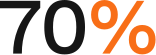
U.S. and Canadian companies can cut payroll costs by up to 70% through nearshore staffing in Mexico.

Cross-border recruiting has never been easier. Explore the global talent pool and unlock new opportunities for growth.

More companies now turn to Mexico for skilled professionals who deliver remote services and operational efficiency.
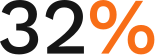
Businesses save up to 32% on cost per hire while gaining the flexibility to scale teams as needed.