Many companies now hire people who work from different places. Some employees work from home, while others live in different countries. This setup helps businesses grow faster and access better talent.
Many of these companies now use a Talent as a Service (TaaS) model to build flexible teams without long hiring cycles. This approach allows them to scale faster and maintain quality across roles.
However, managing a remote team is not always simple. Leaders need to make sure everyone understands their tasks, communicates clearly, and stays productive. Without the right systems, teams can lose time and risk making mistakes.
Artificial intelligence (AI) helps solve these problems. It supports communication, organizes work, and helps leaders make better decisions. These changes are shaping how companies handle remote workforce management and how they grow over time.
Artificial intelligence, or AI, is software that can read information, find patterns, and make simple decisions using that information. Instead of following only fixed instructions, AI systems adjust their actions based on what they observe.
In simple terms, AI works as a digital helper that can read, listen, and organize information quickly. It can summarize conversations, suggest the next steps, and detect patterns that are hard to see manually.
Good communication helps every team succeed. This becomes even more important in a distributed team, where people do not work in the same place.
Remote work removes face-to-face interaction. Team members cannot always see body language or hear tone clearly. This can lead to confusion and delays.
AI tools now support clearer and more effective communication within teams. Some tools can turn speech into written text during meetings. Others can translate conversations into different languages in real time. This helps team members understand each other, even if they speak different languages.
For example, AI-powered transcription tools record meetings and create written notes. Team members can review conversations instead of using their memory. This reduces confusion and helps everyone stay aligned.
Slack has also changed how teams communicate. It now includes AI features that summarize long conversations. Instead of reading many messages, employees can review a short summary and understand the main points.
These tools help teams share information clearly and reduce errors. They also help new team members understand past discussions more quickly.
Many remote teams rely on frequent meetings to stay connected. While meetings help teams talk, too many meetings can slow down work.
AI reduces the need for constant meetings. It does this by organizing information and sharing updates automatically.
Modern AI tools can summarize discussions, track tasks, and show progress in real time. This allows team members to stay informed without joining every call.
For example, Fireflies.ai can join virtual meetings on its own. It records the conversation and creates a summary with key points and action items. Team members can review this later instead of attending the meeting.
Monday also uses AI to manage tasks and workflows. The system tracks tasks and shows who should do each one. This keeps projects moving without constant check-ins.
These tools improve remote team management because they reduce wasted time and keep everyone focused on their work.
Many daily tasks take time but do not require deep thinking. These include updating project status, assigning tasks, or sending reminders.
AI enables teams to complete these tasks more efficiently. It can assign work, update progress, and trigger actions based on what is happening in a project.
For example, when a team member completes a task, AI assigns the next step to another person automatically. This removes the need for manual updates and keeps work moving.
Automation helps teams focus on important work instead of repetitive tasks. Employees can spend more time solving problems and less time managing small details.
This creates stronger workforce solutions that support growth. It also supports companies that operate with a TaaS team, where clear processes and automation are key to maintaining performance across distributed roles.
Leaders need clear information to guide their teams. Without it, they may make decisions based on guesses.
AI collects data from different tools and turns it into useful insights. These insights show how work is progressing and where problems may occur.
For example, AI shows when a project is late and when someone has too much work. Managers can act early and prevent bigger issues.
Gartner research shows that companies that use AI to improve how they work are twice as likely to reach their revenue goals. This shows how better decisions lead to stronger results.
AI also introduces new ideas, such as digital copies of top performers. These systems study how high-performing employees work and help others follow similar patterns.
These insights support operational growth because they help leaders improve performance over time.
Remote teams often struggle to stay connected. Without regular interaction, employees may feel disconnected from their work or their team.
AI helps maintain connections by keeping information clear and easy to access. It brings updates, summaries, and task progress into one place.
For example, AI tools can send daily or weekly summaries of team activity. These updates show completed tasks and highlight what still needs attention.
This helps team members stay informed without extra effort. It also helps managers track progress without asking for constant updates.
Over time, this creates a more organized and stable work environment.
Work continues to change as AI becomes part of daily operations. Companies now manage both people and technology at the same time.
Three main trends shape the future of work:
First, teams must learn how humans and machines work together. This includes adapting to new tools and ways of working.
Second, companies must address risks such as hiring fraud and internal issues. AI helps detect unusual behavior and protect company data.
Third, organizations must redesign how work happens. They use AI to improve processes and make work faster and more efficient.
These changes require leaders to think differently about how they manage teams and systems.
AI changes how companies operate every day. Teams spend less time on repetitive work and more time on meaningful tasks.
Communication becomes clearer because teams rely on written summaries and real-time translations. This reduces confusion and helps projects move faster.
Leaders gain better visibility in their teams. They can see what is happening in real time and make quick decisions when needed.
Companies that struggle to find or manage talent benefit the most. AI helps them organize work, reduce delays, and improve team performance.
For example, businesses that cannot find local talent often use TaaS to access skilled remote professionals. AI helps manage these teams effectively and keeps them aligned with company goals.
This creates a system where companies can grow without losing control.
AI is transforming how companies manage remote teams. It helps leaders organize work, improve communication, and make better decisions.
Companies that use AI tools can grow faster and manage larger teams without adding complexity. They build systems that support long-term success.
If your company wants to manage remote teams better and grow with the right setup, review how our process works. Learn how we help you build and manage a remote team with clear structure and reliable results.
Discover the cost and performance advantages of global recruitment and nearshore outsourcing.
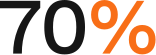
U.S. and Canadian companies can cut payroll costs by up to 70% through nearshore staffing in Mexico.

Cross-border recruiting has never been easier. Explore the global talent pool and unlock new opportunities for growth.

More companies now turn to Mexico for skilled professionals who deliver remote services and operational efficiency.

Businesses save up to 32% on cost per hire while gaining the flexibility to scale teams as needed.