
Your company values are on your website. You discuss company culture in every all-hands meeting. But the team you envisioned when you wrote those values does not always match the team you see today.
Your team is present, but the level of commitment and energy that once defined your team has shifted. Communication feels transactional. And the culture you build feels harder to maintain now that everyone works from different cities.
Most leaders eventually discover that replicating office culture does not work in a remote environment. Distributed teams require a different approach to building culture. With specific goals, clear habits, and the kind of leadership that is present consistently, not just in quarterly reviews.
This guide breaks down exactly what that looks like in practice.
Most leaders assume remote culture breaks down because of distance. The real reason is different: unclear expectations break it down.
In a physical office, culture spreads naturally through daily interactions. Through conversations in a hallway, body language in a meeting, or the way a manager responds at any moment. It also lives in the unspoken norms that everyone absorbs just by being in the same room.
When those signals disappear, values become abstract. And abstract values rarely translate into consistent behavior.
The data confirms this. Low engagement is already a challenge. For remote teams without clear communication or visible leadership, engagement drops even lower.
Nearly 19% of remote employees struggle to build strong working relationships, which directly affects trust, collaboration, and retention.
Culture is not what a company says. Harvard's research shows 70% of an employee's experience at work comes from their manager's behavior. Culture is not what you write in a document, it's what your leaders do every day.
The good news is that engagement and culture are not out of your control. With the right leadership and team structure, both can improve. But it requires replacing vague intentions with specific, measurable cultural goals.
Company values are principles: honesty, excellence, and collaboration. They define what you stand for.
Cultural goals are the specific, actionable behaviors that bring those values to life. They answer a different question: not "what do we believe?" but "what do we actually do?"
Values tell you what a company believes. Cultural goals translate those beliefs into specific behaviors and expectations that play out every single day. Instead of "we communicate openly," a cultural goal looks like this:
Written feedback within 48 hours of a milestone
A one-on-one check-in with every direct report at least twice a month
The difference matters enormously in a remote environment. Without shared physical space, the small moments that normally build trust and alignment simply do not happen on their own. Your team needs clear, intentional, and measurable cultural behaviors to stay aligned.
The best cultural goals follow the SMART framework: Specific, Measurable, Achievable, Relevant, and Time-bound. Here are examples across the areas that matter most in a remote team.
Vague version: "We want better communication across the team."
SMART version: "Post a written project update every Friday by 5 PM. Cover progress, blockers, and next steps. Leadership checks these updates once a month."
Why it works: Remote employees who hear regularly from leadership report 58% higher trust and alignment with company direction. Structured communication creates consistency.
Vague version: "We want people to feel appreciated."
SMART version: "Managers will publicly recognize at least one talent contribution per week in the team channel. Every quarter, starting Q3, the all-hands call will include a moment to recognize a teammate."
Why it works: Recognition is one of the highest-impact culture levers in remote environments. In a remote team, there are no casual moments. Small acts of public recognition replace them and keep people feeling seen.
Vague version: "Leaders should be more accessible."
SMART version: "Managers meet one-on-one with each direct report every two weeks. Any team member can also book a 30-minute open block with their manager if they need it. Response time to direct messages will not exceed 4 business hours."
Why it works: Leaders do more than influence the culture. They define it, whether they intend to or not. Structuring it removes the gap between intention and execution.
Vague version: "We want people to feel comfortable speaking up."
SMART version: "Leadership sends a 5-question anonymous pulse survey to the full team on the last Monday of each month. Within two weeks, leadership shares the results and a written response outlining what will change."
Why it works: Closing the feedback loop is what builds trust. A survey with no follow-up sends a clear message, even if leadership never intended it. It tells your team that their feedback goes nowhere, and over time, that silence erodes the trust you need to build a strong culture. Surveys with clear follow-ups teach them the opposite.
Vague version: "Make every new hire feel welcomed from day one." (But what does that actually mean, and who is responsible for making it happen?)
SMART version: "Every new talent completes a 30-60-90-day onboarding plan. Along the way, they join at least three informal video calls with teammates outside their project. At day 30, they fill out a short survey to share how the experience is going."
Why it works: In remote teams, integration doesn't happen automatically. When talent joins from Mexico or other LATAM countries, intentional onboarding makes the difference. It closes the cultural gap and sets the working relationship up for long-term success.
You can design the best cultural framework in the world. Consistency from leadership is what makes culture real. Without it, even the best cultural goals stay on paper. Culture starts with leadership. Leaders shape culture through the tone they set and the standards they uphold every day.
Here are SMART leadership goals that build culture from the top down:
SMART goal for transparency: Every Monday, send a short-written update to the whole team. Cover three things: what the company is focused on right now, decisions made last week, and what's coming up next. Track readership and adjust format based on team feedback.
SMART goal for empathy: Begin every one-on-one with one non-work question. Document themes from those conversations quarterly to identify team-wide needs before they become problems.
SMART goal for growth and development: Every team member has a development goal. Managers revisit it every month in one-on-ones. Each manager dedicates at least one 30-minute meeting per quarter to career conversation, not project status.
SMART goal for cultural momentum: As Forbes Business Council describes it, culture is an action, not a declaration. Each month, leaders pick one cultural behavior to model publicly and explain to the team why it matters.
In a remote team, culture takes consistent, intentional effort from everyone. Use this framework to hit your work culture goals and build a team that stays strong, no matter where your people work.
Take each company's value and translate it into one specific, observable behavior. Record your values and share them across your team. Make them the lens through which you give feedback, recognize contributions, and evaluate team performance.
Every remote team runs on recurring rituals: daily standups, Monday kick-offs, onboarding calls, and team channels. These moments shape culture, whether your team plans them that way or not.
The real question is whether those rituals reinforce the culture you want to build. Set smart goals for leadership around each one. Review them regularly and redesign any that are not actively supporting your culture.
A meeting that moves a project forward and a moment that builds a sense of belonging serve different purposes. Both are essential. Design each one with intention.
A strong work culture is visible in the data. Use pulse surveys, one-on-one check-ins, and engagement metrics to measure whether your cultural goals are taking hold. When the numbers signal a gap, adjust your approach before it grows.
When your team shares feedback, make your response visible and your follow-through consistent. Nothing kills a culture of openness faster than leadership asking for input and then going quiet. When people see that their feedback leads to action, they keep giving it to them.
Remote teams that include nearshore talent from Mexico follow the same cultural principles as any distributed team. The key addition is intentional integration.
Nearshore professionals already bring strong English skills, U.S. business knowledge, and time zones that line up with your team. What leadership needs to provide is simple: clear expectations, consistent recognition, and a culture that genuinely includes every talent.
Adding this to your examples of smart leadership goals makes a real difference. Include your talent from day one, and your team will perform better and stay longer.
A few practical moves that make a difference with cross-border teams:
Bring nearshore talent into all-hands calls and company-wide communications as a standard practice. Leaders build culture by creating shared experiences. If your nearshore team misses the moments that matter, they'll feel like contractors, not colleagues.
Set explicit communication norms across the team. Not "be responsive" but "respond to Slack messages within 2 business hours, and flag if you need more time." Clarity removes uncertainty across cultures.
Make recognition a visible and regular practice. Recognize nearshore talent in front of the whole team; they will stay, grow, and bring others with them.
Leaders build strong remote culture through consistent, measurable behavior over time. Mission statements alone will not get you there.
Companies that invest in culture early grow with a stronger, more united team. They have a competitive advantage. Their teams stay longer, perform better, and attract better talent because working there actually feels like something.
Building a remote or hybrid team? Start with talent that integrates quickly, communicates clearly, and strengthens the culture you are working on.
At Remoto Workforce, we place bilingual nearshore talent within 10 days through personalized headhunting. Your company saves up to 60% compared to hiring locally. Let's talk.The right people make culture easier to build.
Discover the cost and performance advantages of global recruitment and nearshore outsourcing.
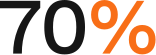
U.S. and Canadian companies can cut payroll costs by up to 70% through nearshore staffing in Mexico.

Cross-border recruiting has never been easier. Explore the global talent pool and unlock new opportunities for growth.

More companies now turn to Mexico for skilled professionals who deliver remote services and operational efficiency.

Businesses save up to 32% on cost per hire while gaining the flexibility to scale teams as needed.