If you've ever read a self-evaluation that said, "I'm a great team player with a positive attitude," you may have spotted an issue. It reads well, but it lacks substance: no results, no growth, no measurable impact.
As a manager of a remote team, self-evaluation can be hard to interpret. Without daily in-person interaction, it's easy to miss what's happening with each team member's growth and goals. A well-structured self-evaluation changes that. It gives you the clarity you need to support your talent and make better decisions from a distance.
When used correctly, self-evaluations are one of the most powerful tools available to remote managers. They create a direct line of insight into each team member's perspective, progress, and priorities. But to get real value from them, your talent needs to know how to write them well, and you need to know what good answers look like. This guide gives you both.
In an office, managers see how work happens. They notice who stays late, who leads informal conversations, who volunteers for the hard project. In a remote environment, none of that is visible.
That gap makes self-evaluation more important than ever. It becomes one of the few structured moments where your talent can document what they did, how they did it, and what it achieved. For you as a manager, it's often the clearest window into the day-to-day work that happens off your radar.
Most people have never learned how to write a self-evaluation well. Without guidance, most self-evaluations stay surface-level. They focus on effort and attitude, not outcomes and growth.
Research from Harvard Kennedy School found that managers anchor their ratings directly to employee self-assessments. A vague or underselling self-evaluation does not just fail to impress. It can directly impact the final score.
On the flip side, only 14% of employees find performance reviews genuinely inspiring. Most see them as formality. As a manager, your job is to change that by raising the standard of what good self-reflection looks like on your team.
And as Forbes has noted, self-reviews feel like a waste of time only when treated as a formality. When structured properly, they become a genuine development tool.
Before diving into self-assessment examples, here's the framework your team should use every time. Strong self-evaluations do four things:
Before: "I worked hard on client communications this quarter." After: "I restructured our client update process, reducing response time from 48 hours to under 6 hours. The client flagged it as a major improvement in our Q3 review."
Percentages, time saved, volume handled, satisfaction scores, error rates, turnaround times. Numbers make contributions visible. The most effective self-assessments use action verbs and specific numbers. Think "reduced response time by 40%" or "delivered 3 projects ahead of schedule."
Before: "Focus is an area I’m actively working on to improve." After: "In Q3, I started blocking time on my calendar each day to get the most important work done first. I also set up biweekly meetings with my manager to keep my workload on track."
A self-evaluation performance review that only discusses personal achievement misses the point. The best ones show how individual contributions moved something bigger forward.
Here are ready-to-use self-evaluation examples for work across the areas that matter most for remote teams. The employee writes each example from their own point of view. Managers can use them as a reference or adapt them to fit their team's review process.
Strong example: "This quarter I started sending written meeting summaries within two hours of every call. My manager said it reduced follow-up requests across the team and helped onboard two new team members faster than before."
Strong example: "I maintained an average response time of under 90 minutes for all internal messages during business hours. On busier weeks, I let my manager know when my workload was getting too high, before it affected any deadlines."
Growth area example: "My async communication was inconsistent in Q2. To fix that, I started sending a daily status update every morning and checking messages at two set times: 9 AM and 2 PM. Response times improved and the team reported fewer gaps."
Strong example: "I led the Q3 onboarding redesign for our nearshore team. I documented process gaps and partnered with HR to update the 30-60-90 plan from start to end. New talent ramp time dropped from six weeks to four, across eight hires this quarter."
Strong example: "When an issue came up in week two, I told leadership within four hours and gave them three options to fix it. After that I put the approved fix in place without missing the final deadline."
Strong example: "I mentored two junior team members this quarter. Both flagged in their check-ins that our sessions helped them resolve blockers faster. One of them successfully led their first solo client call in Q3."
Strong example: "I redesigned our weekly standup format to work better for our distributed team. Participation went from 60% to 95% after the change. Two team members said it was the first time they felt heard in a group meeting."
Growth area example: "I want to improve how I give constructive feedback to peers. I enrolled in a feedback workshop and started using the SBI model in my one-on-ones to give clearer feedback. I'll revisit this with my manager in our Q4 check-in."
Strong example: "I helped the team stay organized by building a shared project tracker that everyone updates in real time. Status update requests to me dropped by 70% after implementation."
Strong example: "My team works across U.S. and Mexico time zones. I scheduled shared hours for high-priority work and used async tools for routine updates. This approach kept the project on schedule without requiring after-hours availability from any team member."
Over half of remote employees feel misunderstood during performance reviews because evaluation criteria don't reflect the realities of distributed work. The examples above fix this situation by naming contributions that remote managers value.
Strong example: "My goal for Q3 was to improve client retention in my account portfolio by 10%. I ended the quarter at 14% improvement. I set up regular check-ins and flagged two accounts that needed attention to leadership two weeks before renewal calls."
Strong example: "I exceeded my output targets by 18% this quarter while maintaining quality scores above the team average. I did this by batching similar tasks, reducing context-switching, and blocking two focused hours each morning for deep work."
A self-evaluation tells you as much about how someone thinks as it does about what they accomplished. Here's what managers should look for in these examples.
Specific numbers and outcomes, not general claims about effort or attitude.
Honest acknowledgment of growth areas with a concrete action plan already in progress.
Contributions on team or business impact, not just personal achievement.
Language that mirrors the team's actual goals and review criteria.
For remote talent: explicit naming of async contributions, documentation habits, and cross-time zone coordination.
"I'm a team player" or "I work hard" are self-assessments with no evidence to support either claim.
Achievements with no clear connection to a project, goal, or metric.
Growth areas listed with no plan or action taken. This signals low self-awareness or disengagement.
A self-rating significantly higher or lower than your own observation. Both gaps deserve direct conversation.
As Forbes highlights, performance reviews only work for both sides when they are based on specific results. The manager's job is to hold that standard and coach the team toward it.
If your team consistently submits weak self-evaluations, that's a system problem, not a talent problem. Here is what you can do to strengthen your next review cycle.
Most people have never seen an effective self-evaluation. Showing a clear example makes a significant difference. Use unnamed examples from previous cycles or write a sample yourself based on a fictional team member's quarter. Establish a clear visual benchmark.
Without clear criteria, your talent has no baseline to evaluate themselves against. Share the review framework, competencies, and rating scale before they start writing, not after. Review forms with 10 to 15 focused questions consistently produce better results than formats that are too short or too long.
Self-evaluations are harder to write when people have to recall work from six months ago. Build a habit: a monthly "wins and learnings" note, a shared doc they update weekly, or a standing agenda item in one-on-ones. When the review opens, they already have the material.
As Forbes notes on AI performance reviews, the shift toward data-driven evaluation is increasing. Teams that track their work with numbers and results will have an easier time in every review cycle.
A self-evaluation works best when it starts a real conversation between the manager and talent. After reading it, come one-on-one with two or three specific follow-up questions.
Where did you run into the biggest obstacles while working toward your goals this quarter?
What would you approach differently next time?
What resources or support would help you perform at your best next quarter?
That's where real development happens.
Most talent underreport their contributions. This is especially true for nearshore professionals, who may not be sure which of their skills count as "work" in a formal review.
Here is what you can do as a manager:
Share this guide before the review cycle starts. Give your talent time to think about contributions they might have missed. A two-week heads-up makes a real difference in the quality of what they submit.
Ask specific questions. Instead of "How did you contribute this quarter?" try:
"What did you do to keep both sides of the team aligned?"
"Were there moments where your bilingual skills solved a problem?"
"How did you handle a situation where the two teams had different expectations?"
Name it yourself first. If you notice a talent stepping up on cross-border coordination, say so in your manager's notes. When managers notice these contributions, talent starts reporting them more clearly.
Create space within the form. If your self-evaluation form does not have a section for collaboration or communication skills, add one. A single open-ended question like "How did you support cross-team work this quarter?" gives your nearshore talent room to show what they bring.
Companies that manage nearshore teams will get more done. They also build something lasting: a connected team with a shared language and the trust that makes remote work succeed.
It starts with managers who pay attention to what their talent actually contributes. And with talent who have the tools to communicate that value clearly.
Self-evaluations are not just formal. When done right, they are a record of what your team is building together.
Ready to build a nearshore team that performs at the highest level?
Remoto Workforce places bilingual talent from Mexico in 10 days, at up to 60% less than a local hire. We handle the sourcing, screening, and coordination so you can focus on results.
Discover the cost and performance advantages of global recruitment and nearshore outsourcing.
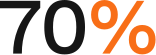
U.S. and Canadian companies can cut payroll costs by up to 70% through nearshore staffing in Mexico.

Cross-border recruiting has never been easier. Explore the global talent pool and unlock new opportunities for growth.

More companies now turn to Mexico for skilled professionals who deliver remote services and operational efficiency.
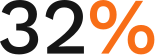
Businesses save up to 32% on cost per hire while gaining the flexibility to scale teams as needed.